

The Need for a Digitalization Strategy
By Greg Brolund
In an earlier post we talked about a learning from our 2022 World Class Regulatory Information Management (RIM) survey that an important question for Regulatory is “what’s next?”. We can get a glimpse from other industries of a possible future for managing regulatory information in the most efficient and accurate way possible. Volkswagen has one of the largest manufacturing facilities in the world in Wolfsburg Germany. It covers almost 15,000 acres, produces 3,500 cars per day, has thousands of employees and, importantly, uses 5,000 robots and is reported to be over 90% automated. Automation at this level is supported by a comprehensive digital strategy and architecture, intelligent automation and standard processes and organizational support.
One piece of the puzzle for the regulatory equivalent of using robots to achieve Volkswagen’s level of automation and efficiency is robotic process automation (RPA).
So, what does regulatory need to do to use RPA to improve efficiency through reduction of manual efforts, and to free critical resources for higher value activities? We believe it is critical to develop a coordinated and comprehensive digital and intelligent automation strategy that includes foundational, strategic and transactional elements. All three are ultimately required and must work in concert to be effective.
Let’s look a each layer.
Foundation
Strategic
Transactional
The 2020 World Class RIM survey identified significant investments in technology in each layer. We believe development in each layer can be concurrent if there is an overall digital strategy and architecture that encompasses all layers. Think of a jigsaw puzzle. You can add pieces anywhere in the puzzle. You don’t have to start at the bottom or an edge, as long as all the pieces fit together when you are finished. (For fans of The Big Bang Theory TV show, Sheldon was wrong in the scavenger hunt episode.) The figure below shows the technology areas that were identified in the 2022 WCRIM. The percentages shown are the percent of companies with moderate or significant investments in each area. In the diagram, we also proposed a possible alignment of each technology with an architecture layer.
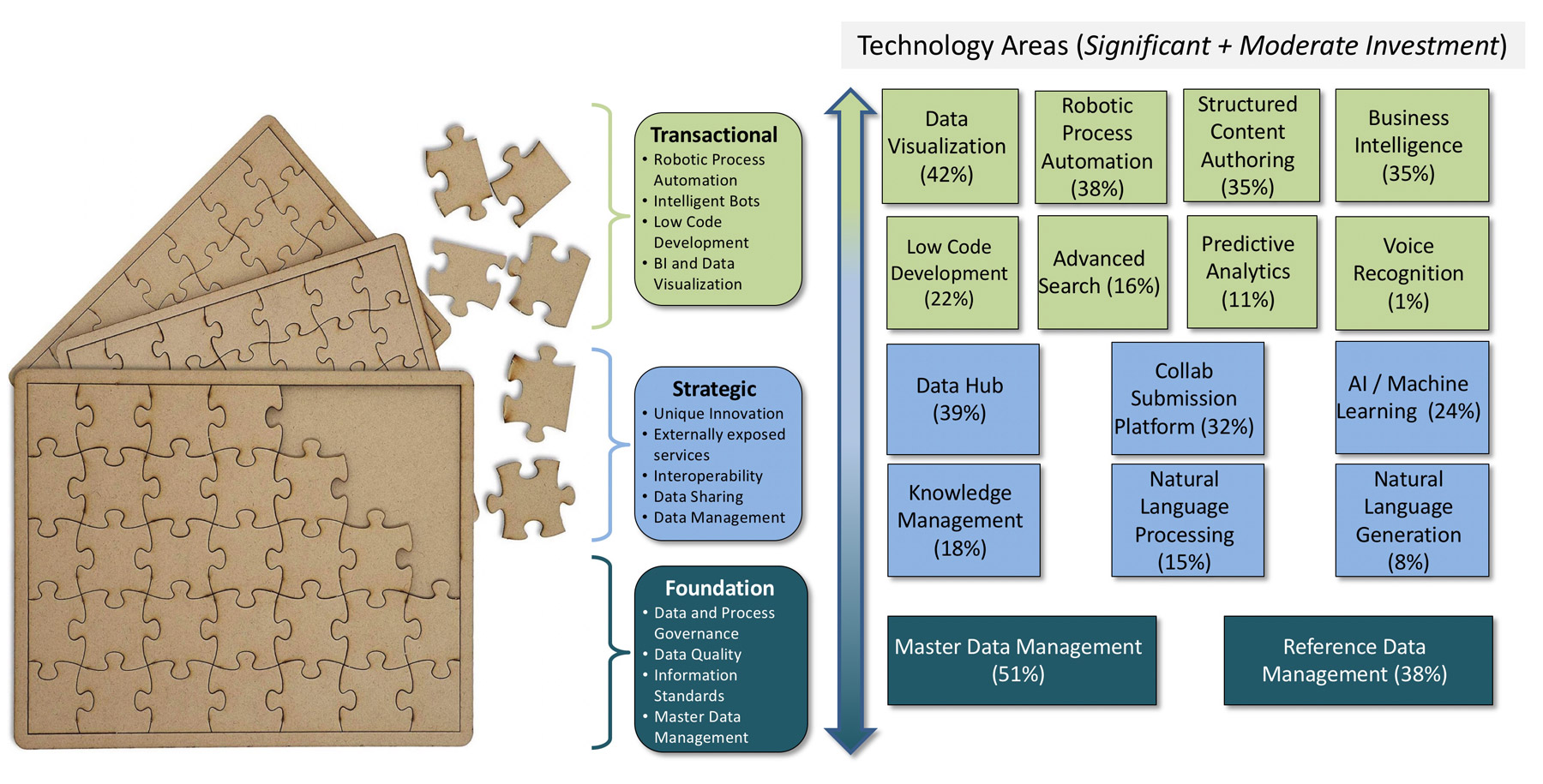
As you can see, there is investment across the entire spectrum which corresponds to the pressures at each layer we have observed when working with our clients. There are upward and downward pressures. From the foundation layer, there is pressure from the enterprise to establish the foundation and strategic elements. Unfortunately, these elements typically require relatively long implementation times. There is also pressure to implement transactional elements to provide immediate relief from inefficient or routine manual work.